
Submarine Film Poses Deep Study - Part 2
|

![[<< First]](navimages/tsign_purple_first.gif "[<< First]")
![[< Previous]](navimages/tsign_purple_previous.gif "[< Previous]")
![[Next >]](navimages/tsign_purple_next.gif "[Next >]")
![[Last >>]](navimages/tsign_purple_last.gif "[Last >>]")
|
|
SUBMARINE FILM POSES DEEP STUDY
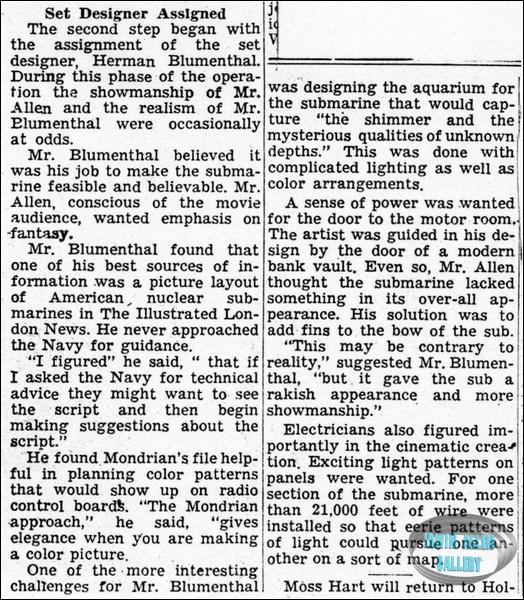
Producer, Researcher and Designer Rise to Challenge of 'Voyage to Bottom' By MURRAY SCHUMACH Special to The New York Times. HOLLYWOOD, Calif, Feb. 23 -Showmanship has brought together art and science at the Twentieth Century-Fox movie studio and the result is a futuristic nuclear submarine that might startle Vice Admiral Hyman G. Rickover. But the submarine, which is in the form or several movie sets on one sound stage, pleases Irwin Allen, who has produced, directed and co-authored the movie "Voyage to the Bottom of the Sea." These days, such actors as Walter Pidgeon, Joan Fontaine. Peter Lorre, Barbara Eden and Frankie Avalon seem quite at ease among metallic compartments, flashing lights, submarine missiles and a small submarine carried by the Hollywood-built nuclear sub. But in some ways there are almost as many problems in building this movie submarine as for the genuine article. Long before there was a script, Mr. Allen detailed a researcher, Elizabeth Emanuel, to compile information. Through the Navy she tracked down manufacturers of parts for nuclear subs. They gave her whatever information and pictures were not confidential. She foraged in the library and consulted with scientists at universities in southern California. Set Designer Assigned The second step began with the assignment of the set designer, Herman Blumenthal. During this phase of the operation the showmanship of Mr. Allen and the realism of Mr. Blumenthal were occasionally at odds. Mr. Blumenthal believed it was his job to make the submarine feasible and believable. Mr. Allen, conscious of the movie audience, wanted emphasis on fantasy. Mr. Blumenthal found that one of his best sources of information was a picture layout of American nuclear submarines in The Illustrated London News. He never approached the Navy for guidance. "I figured" he said, "that if I asked the Navy for technical advice they might want to see the script and then begin making suggestions about the script." He found Mondrian's file helpful in planning color patterns that would show up on radio control boards. "The Mondrian approach," he said, "gives elegance when you are making, a color picture." One of the more interesting challenges for Mr. Blumenthal was designing the aquarium for the submarine that would capture "the shimmer and the mysterious qualities of unknown depths." This was done with complicated lighting as well as color arrangements. A sense of power was wanted for the door to the motor room. The artist was guided in his design by the door of a modern bank vault. Even so, Mr. Allen thought the submarine lacked something in its over-all appearance. His solution was to add fins to the bow of the sub. "This may be contrary to reality," suggested Mr. Blumenthal, "but it gave the sub a rakish appearance and more showmanship." Electricians also figured importantly in the cinematic creation. Exciting light patterns on panels were wanted. For one section of the submarine, more than 21,000 feet of wire were installed so that eerie patterns of light could pursue one another on a sort of map. |
Photo Credits
Elizabeth Emanuel
This gallery showcases Voyage to the Bottom of the Sea Movie collectibles, props, and photos etc, many shared with us by others interested in this classic movie. If you have any interesting Voyage to the Bottom of the Sea Movie photos and collectibles that you think others would enjoy seeing, please feel free to email over some pictures. Please let us know the name to credit with each photo (can be full name, nickname, initials etc). Thank you to everyone who has provided material for this gallery.